Posts

Showing posts with the label Autoimmune Disease in women

It will take more than 10,000 experiments!
Image
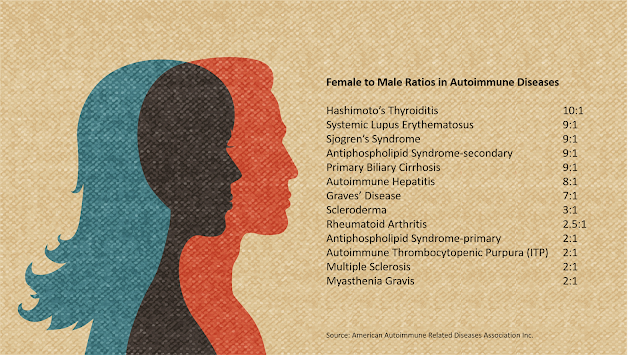
The Doris Howell Foundation held its first Luncheon Series with the lecture “ Understanding the genome 10,000 experiments at a time: applying genomic approaches to understand autoimmune disease in women" with Sonia Sharma, Ph.D., Assistant Professor, Division of Cell Biology, La Jolla Institute for Allergy and Immunology and Director of the Institute’s RNAi Facility. Although the title sounds intimidating,  the fact is autoimmune diseases affect women to a much greater extent than men (See Table). Currently in the US 12 million women and 4 million men are struggling with autoimmune disease; not to mention that research on autoimmune diseases in women has been scattered and unfocused, partly because of the fact that symptoms are often confused with other conditions. For reasons that are yet not fully understood, autoimmune diseases affect more women than men. Dr. Sharma pointed out that women have higher immune reactivity and higher numbers of certain immune cell popula...

First 2016 Howell Luncheon to Address Autoimmune Diseases in Women.

Image
The Doris Howell Foundation starts the year with the lecture “Understanding the genome 10,000 experiments at a time: applying genomic approaches to understand autoimmune disease in women" with Sonia Sharma, Ph.D., Assistant Professor, Division of Cell Biology, La Jolla Institute for Allergy and Immunology and Director of the Institute’s RNAi Facility. I want to say that, as with everything that has to do with women, 10,000 experiments to better understand autoimmune disease in women sounds about right.  But ask any woman with an autoimmune disease, and it is definitely no laughing matter; even though the warriors that live with autoimmune disease might often joke about it themselves.   For reasons that are yet not fully understood, autoimmune diseases affect more women than men.  As an example: The statistics are stunning! According to the American Autoimmune Related Diseases Association, Inc.:   To start, it is quite diff...